Prompt 2: Extend a reflection on a single moment (statement, activity, rap, muffin, or termite) from the SI (summer institute)--how is that moment sitting with you today?
Well, we talked a lot about cross curriculum writing and I have been thinking about this a lot lately. After I attended the Writing Project Summer Institute, I spent four days in St. Louis doing training for our science curriculum.
The CEO of the company made a statement on the very first night that has stuck with me, "This curriculum is solid if taught as is, but is even better if taught using current events, writing, and other resources."
As we were discussing writing within science, many of the teachers were stuck on having students write the process of the experiments we would be doing. So, with a bit of encouragement from a colleague, I spoke up.
We had studied a whole lesson about pelicans and we were purposing ways to write about this lesson. So I suggested these different avenues:
- Argument: You could write an argument to save the pelicans ecosystem
- Informative: A brochure about the Pelican
- Explanatory: Write about how birds adapt to where they live based on their beaks and
what they can eat with their beaks (this would be explaining the experiment, but don't have
them do this in "step one, step two" format)
- Narrative: Write a narrative from the pelicans point of view about why they live in that
specific ecosystem.
Teachers from all over the nation that came together for this training, sat there and stared at me like I was an idiot for my suggestions. However, their spoken reaction was, "Wow, how do we come up with different things like that for each lesson? I would have never thought of that." My answer was, "now you see how limitless writing can be, collaborate and ask Sangari people for suggestions, they can help us all network to provide a medium to share our ideas.
I got off into a little tangent there, but this all took be back to the writing project. I see writing as so much more than a process now. I see it as a way to express feelings and a way to share what we understand but the format doesn't have to be the same to do so. Writing does not always need to be graded for perfect grammar, especially within content areas. Students should be able to write freely without being marked about with red marks, but students should also be taught to write properly. Each paper has a different purpose, and I think it is important to help students determine those purposes.
Thursday, July 25, 2013

Geeked about...
To readers -- The group I worked with in the writing project are working on blogging regularly. We throw prompts at each other.
This weeks prompt:
This weeks prompt:
Wednesday, July 10, 2013
O.R.E.O
O. Opinion
R. Reasons/Research
E. Example
O. Opinion
You can use this format for any opinion piece (could be about something silly, could be about something scientific, mathematical). It is like the hamburger writing.
O. Students write their opinion.
R. They come up with 3 reasons they have that opinion (usually based on research or something they have read or heard depending on grade level)
E. Students give an example to back up their opinion
O. Students restate their opinion. Must teach students to write the same opinion as they did in the beginning, but using different wording.
*Note: Some students change their opinion while writing, I think that is important to recognize and not dismiss. We all explore, learn, read, and change our minds regularly. That is higher level thinking if students can recognize the changing of opinion.
Clarifying (I pulled these off Google, there are others on Pinterest. I made my own for students with lines on it but of course can not find the document.)

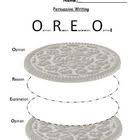
R. Reasons/Research
E. Example
O. Opinion
You can use this format for any opinion piece (could be about something silly, could be about something scientific, mathematical). It is like the hamburger writing.
O. Students write their opinion.
R. They come up with 3 reasons they have that opinion (usually based on research or something they have read or heard depending on grade level)
E. Students give an example to back up their opinion
O. Students restate their opinion. Must teach students to write the same opinion as they did in the beginning, but using different wording.
*Note: Some students change their opinion while writing, I think that is important to recognize and not dismiss. We all explore, learn, read, and change our minds regularly. That is higher level thinking if students can recognize the changing of opinion.
Clarifying (I pulled these off Google, there are others on Pinterest. I made my own for students with lines on it but of course can not find the document.)
Monday, July 8, 2013
Zoom Zoom Zoom
Time is going by so quickly.
I am not updating like I said I would.
Coming Soon....
-Weekly prompt response
- Lesson plan ideas/strategies by category based on Writing Project Presentations and discussions (this is a big task)
- Everyone's essential question from Writing Project in a blog with a synopsis of the "solution"
- Mentor texts - suggested text and description of each text.
In the meantime this is what has been happening ---------------
- I travelled to Nebraska to visit family
- Went camping at a lake with friends on the 3rd
- My home town put on a decent firework display
- My nephew has learned what it means to tickle someone (he is 2)
- My nephew spotted a coyote in the distance - young eyes!
- I bought a CD (first one in years!) because the radio stations up there are so terrible...
- That CD is stuck in my brothers pickup CD player
- Playing Blitz is more fun than I ever thought it could be.
- I learned if you don't know how to an answer "on a scale to 1 to 10" question with doctors, "Just say 8"
- I bought children's CD's for my classroom at goodwill
- My mom and I sang kids songs for an hour from Hastings, NE back to Superior, NE
- I miss children's songs!
- My mom bought about 50 books for my classroom library for 50 cents each (awesome donor to students education)
- Dirt track races become more interesting when it rained that day
- It is impossible not to run into cars when it has raced
- My 15 year old cousin can not drive well and I fully understand why my mom hated me when I was learning to drive.
- Pit crew guys really don't know what to do when something happens, they just put on an awesome show!
- Lea, at La Trap Nails in KCMO, does AWESOME work!
- State Line Nissan sucks - don't go there! McCarthy here I come!
- Always ask to see your cars tires when getting an oil change and watch for the wear on them yourself, you can't rely on anyone!
- 220.00 on bad service can make you say dumb things.....
-"I maybe 23 and a female, but I'm not a damn yuppie" did come out of my mouth this week....
- The closer you drive to St. Louis, the faster people drive, but they still aren't terrible drivers.
- When the speed limit says 60, and most people are driving 80, you speed.
- The Busch Stadium is DOWN TOWN...
- The arch isn't as big as the post cards make it seem.
- The Mississippi River smells like Brush Creek
- Italian Ice Cream is the best ice cream
- The Drury Inn in is pretty spectacular, never would have thought it was this nice
- Science teachers are not boring
- Having a hotel room to yourself is not nearly as fun as sharing
- The Old Spaghetti Factory is a great place!
That is all for now - very random - but nice for me to reflect on. Real Writing to come this week!
Friday, June 21, 2013
Ready for Next Year! Uplifting Day!
A book suggested to me: If She Only Knew Me – Jeff Gray and
Heather Thomas
Paul’s TIW
Story Writing
-
Louder Than a Bomb – poetry slam organization
-
Now Me, New Me – piece of paper divided into two
sides. Left side said is “Now Me” and right side said is “New Me”. You give
students a topic. “Productivity” “health” “relationships” and they write a
statement as to what is going on today. On the now side, you write the same
sentence in a way you wish it were in present tense form.
-
Example: “I don’t trust people enough to build
new friendships often” à
“I give people a chance before using trust as an excuse”
-
7-day Challenge – the students are challenged to
doing good deeds. Day 1 they do 1 good deed, Day 2 they do 2 good deeds, all
the way up to 7 good deeds on day 7. They also encourage a new person to join
the 7-day Challenge each day of the Challenge.
-
The (school name) Wordshop – get away from
curricular activities – place for students to go write, create, act, perform
(stage, coffee shop, tables, lounge area)
-
Letting Go – writing poems about something they
need to let go, heal over, grieve over. Put the poems in a balloon and let them
go.
-
This I believe – what is it that students
believe in. Students made video about their belief. “Happiness” was one girl’s
belief in her video.
o
“Shut Up & Smile”
-
Sunshine Law – it was about the government being
transparent but it actually relates to writing and students being able to admit
what bothers us and being transparent about what we feel.
Essential Questions: How can I maintain the engaging and
transformational nature of authentic storytelling while giving necessary
attention to the improvement of academic writing
Jeff Baxter’s TIW
-
Motivating Young Writers
-
Students often are saying
o
Too hard
o
Boring
o
I don’t have anything to say
o
I’ll be wrong
-
He says students who are afraid to start writing
have “Page Fright”
-
Comparing Newton’s Law of Motion to writing. The
first rule of writing is to simply beginning – get moving.
-
Writing is cumulative:
o
Everything you write today prepares us for the
writing task tomorrow
o
Have the courage to write those first words –
stay in motion
o
There is no wasted motion
o
Writing is like a sport – you’ve got to practice
o
Humans are imprinted with the innate desire to
communicate.
-
Teachers write what the students have to write.
Power Writing – do this 3 times a day, twice of a week for 4 weeks (we
are doing layups – practicing)
-
When I say “go”…
-
Write for 1 minute using the word at least once.
o
Write as much as you can
o
As fast as you can
o
As well as you can
-
All 3 rounds at once
-
Content review
-
Pickle
Pickle reminds me of the move
Little Rascals. Little Rascals was my favorite movie as a kid. The little kid,
I think his name was Porky, he had a pickle and he started singing that song,
I’ve sang before, “I have a pickle, I have a pickle, I have a pickle hey hey
hey hey” 55 (number is how many words)
-
It can’t be wrong as long as you make a good
effort and do your best
-
What did you observe?
-
Don’t just make sentence lists or brainstorm
-
What do you notice happening with each
successive round?
-
Why?
Shock
I remember when I was a little
kid, we had electric fence around our house because we lived in the country. My
brother was playing basketball by me and the basketball went on the other side
of the fence. He told me I could go get it, that the fence wouldn’t shock me.
When I touched it the first time, it didn’t shock me, the second time it didn’t
shock me, the third time it did. This is when I learned about the current of
electricity. 86
-
First Essay Writing
-
Students draw a map of a neighborhood they have
lived in and they can get as detailed as they want
-
On the map put the numbers 1-5 in 5 locations
within your neighborhood and make a legend. What were 5 events that happened in
your neighborhood?
-
The students discuss about what good writing is,
what they like, suggestions. It makes students feel proud
Here was my story:
Everyday Jim Loop would pull up to our village mailboxes
between 2pm and 3pm. He would sit and wait for the mailman to come with the
mail. I think Jim Loop was a smart man, so I think he knew the mail never got
there before 4. He was a large man. It was difficult for him to walk. I think
he partly did this because it was easier than getting in and out of his car if
he had been in town. I also think he did it because I talked to him all the
time. The best part of Jim Loop was he had a dog. It was a butterscotch
miniature teacup poodle. That dog was sweet and innocent. Every day I would run
to his car, ask him how he was, then pick Butterscotch out of his arms.
Butterscotch was Jim’s dog, but he didn’t seem to mind me most days. He would
lick my face, cuddle up on my arm, and then scratch me when he was ready for me
to place him back in his owners lap. Not scratch in a “mean dog” way, but in an
“I love you, but I love him more” kind of way. I wanted this dog, or a dog just
like him. I think I told Jim I wanted his dog every day. Jim always said, “You
can’t have my Butterscotch, but you can have this one.” And every day, out of
his shirt pocket he would grab a butterscotch candy. Then he would talk about
school or whatever until the mail man came. I was an excited child, so I would
often run home and tell my mom everything we were talking about, then run back
to talk more. When the mailman would arrive, Jim always handed me his mailbox
key that was around a stretchy lanyard. I’d get his mail, he would tell me how
much he hates bills, then would tell me to have a good night, be good, and see
you tomorrow. I remember the day we all got the letters in the mail that told
us we would all have to move out of these homes. It seemed like no one knew it
was coming. We were a close neighborhood and when I say close, I mean our
houses were close and we knew everything about everyone. I realized later that
this letter, this mailbox, meant no more neighbors. I remember the last day
that Jim Loop checked his mail in that neighborhood. The routine stayed the
same, running to the car, talking, picking up Butterscotch, eating a
butterscotch candy, and talking about whatever an old man and a young girl talk
about, but what changed were his words. “Have a good night, be good, and see
you….around”. My family and I moved further out into country and there I lived
without neighbors nearby until I moved to Kansas City. When I moved to Kansas
City, I was so excited to live around people and have neighbors, but it didn’t
take me long to figure out, neighbors in Kansas City weren’t the same as
neighbors in the Cement Plant Village. Neighbors came and went, but we were family
out there, and is now only a memory.
Beauty (my writing from today)
Today we experienced great things in the morning (separate post) Then we went out in our groups to eat lunch then find a place in the city to sit and write. This was suppose to kind of be our cultural piece...He goes mine...
Beauty
I walked
into the library and I immediately started scoping out a place where we could
all sit. I saw five chairs near the corner of the library and said, “Score!” I
was all excited we were there, excited to write, and excited to be doing this
with amazing people! I grabbed a chair and started pushing it to the window. I
suppose I thought a good view would be a tranquil experience. Nicole said, “It’s
interesting that we put our backs to the culture”. I sat, looked out the window
and saw the divides of J.C. Nichols, the problem of the city. Why did I want to
look at that? For the six years I’ve been in Kansas City and the buildings and ‘skyscapes’
have always stood out to me. As we sat in a row of four by the corner of the
windows in the Plaza Library, I realized beauty is what has been enticing me to
this area for years. But what is beauty? So I turned around to find out.
Although I
probably looked like the odd duck out since I was no longer facing the window
like the rest of my group, I didn’t care, I had a quest to find the heart, the
soul, and the root of the beauty that sucked me to the corner of that library.
I sat and looked around. There didn’t seem to be a sense of urgency anywhere.
Except for this girl, sitting and bouncing her legs. Not in a, “I need to go to
the bathroom” type of way, but a, “this text message just made me very uncomfortable”
type of way. She had a snug summery dress on showing the skin that had been sun
kissed. She had her laptop out and some papers, maybe working on something for
school or waiting on someone to show up, but seemingly disconnected from the
work that laid in front of her and the gadget connected to her thumbs. Everyone
around her seemed nearly motionless.
There was a
middle aged man who seemed like he was in no hurry to hurry up and get out of
here. He looked tired by the way he was sprawled out on the couch. Half slumped
sideways, half sitting. His pale arms held his head up. His clothes were worn,
but not dirty. Tennis shoes that look like they have seen more miles than my car,
but not sloppy. He was looking at atlases. Was he going somewhere or just
wondering where he could be? But again, seemed to be in no hurry to find out.
There were
two old gentleman reading near our group. One who seemed to be intrigued by the
massive novel in his hand. As he read he took big long deep breathes, his lip would
go out every once and awhile. He often put his hand on his head, or rubbed his
cheek with the side of his knuckles as his fist was loosely balled up. His jaw
moved, maybe you could say it dropped, when he moved his hand to his head. He
laid the book on his lap and presses his head down further like he was really
getting into it.
The other
gentleman was floating his way through a magazine. I could not see what kind,
but it had a lot of bright pictures. He was probably twenty years older than
the other man, but looked like his physical health was well, externally at
least.
There was
another man in his mid-twenties sitting at a table with books spread out. He
looks tired, but engaged and interested in what he was looking at and reading.
At that
moment, a young man walks in with arms full of books, a briefcase, and loose
papers. He did not slam the items on the ground, but he seemed to have no care
in the world as to what was going on around him in the library. He sat down
hard in the chair and opened a book. I could see the large title “REAL MONEY”
on the front. He sat and read for about three minutes before getting up and
moving. He walked with a stride, he dressed in a plaid shirt and khakis. The
plaid shirt had a color scheme that oddly matched the freshly cleaned khakis.
He went around the row of books, must have placed something over there, and
walked out the door.
As he was
walking out, a large man walked into the library with a wife beater on tucked
into dirty jeans. He had a white towel around his neck. You could see his sweat
glistening on his face and arms. His steps were heavy as he walked towards the
kiosk to sign up for a computer. He stood around waiting for a computer to come
open. He placed his towel on his chair, sat and began reading something on a
news website.
At that
moment a small child, maybe two or three started crying. Her mom hushed her in
a way that was comforting. A way that my mother would comfort me when I cried.
Her child looked tired, and hot. The older kids that stood near placed their
hand on the child as if to say without speaking, “We understand, but stop
crying.”
At this
time, Nicole asked if we wanted to talk about writings. I always want to talk,
but I was seeing a different side to life, to beauty that I had not recognized,
or took the time to recognize in really long time. I moved to Kansas City and
was always amazed and astonished by beauty, but I looked at beauty by the
buildings and the skylines. I would find beauty when I drove out to the lake to
take pictures of reflections, trees, and nature. But I was realizing while
sitting in that library that the beauty in life comes from the people in it,
not what the people are in.
We packed up
our things and headed to the large conference room to talk about what we wrote.
Nicole and Michelle were stuck. Jeff started to make observations about wealth
in such a powerful way. Then our conversation shifted. In the man van on the
way to the library, we started expressing our desire to be close to one
another. We all agreed that friendships were tough for us. We loved our
friends, so we were either really involved in people’s lives or we were
completely uninvolved. We decided that since we all live in different areas and
worked in different schools we had to find to way to stay attached, to stay
writing, to stay thinking and learning and growing. We decided on having blogs,
we would write together and read each other’s writing. I had a blog already
made, but the other three designed there’s. We wanted to stay connected, to
have a reason to write, an audience that likes, no loves, what we say. We wanted
to feel valued too.
As we were
wrapping up talking and about to walk to the van, Jeff said, “I think we all
agree, that our cultural experience was this group right here.” I looked at
him, like “No dude, I’m going to write about what I saw.” We all kind of
laughed, but what I came to realize is, we too are a part of our culture. The culture
of our lives is what we were surrounded by today.
I walked
into the library and sat with my back turned to true beauty of our city. After
I turned around, the more I looked up, the more I wanted to write. I was
disturbed by moving into the room, but decided a culture isn’t in a stagnate
place, it’s where we are. The beauty is in the people we around. Whether that
is in a library, at a SI session, in our Rite Club, on a street corner, a
crowded restaurant, in our homes, or at our schools.
Beauty is…
Tired
Present
Nervous
Hurried
Interested
Peaceful
Loving
Similar
Different
Kind
Sad
Happy
Together
Beauty is people.
Thursday, June 20, 2013
Technology and Vocabulary!!
Video by Nic Askew: Connected Learning (take aways from
video…great stuff!)
·
We have to educate everyone to be creative and
think about things.· Find a way so learning and learning institutions cannot fail us – they become environments/ecologies
· What do we want kids to learn? What are the goals? What is the content? What is the outcome and how do we get students there? Individualize how students will get there.
· What’s the experience we want students to have? Is the kid engaged?
· We have been so focused on outcomes we forgot the learner and forgot we have a passion for learning
· Mentor or peer who is going to interest and support them in helping find a sense of purpose, how can we bring people together who want to learn together.
· Technology bringing us closer together?
· Work that is always in progress and never be afraid to fail
· Have people outside the classroom become involved in student’s lives. Reading their work.
Technology Ideas
· Today’s Meet: Exit slip, questions
· Reflection blogs
· Edmodo – educational like facebook. There are some downfalls about this.
· Future Me – you can email yourself in the future. You type something now, and it emails you the words later.
· Wordle – typing papers, what word do I use too much?
· Padlet – type in responses and the pop on the screen – good for teachers with 1-2-1 computers for students.
You teach the scientist, the science, then the technology
You teach
the mathematician, the math, then the technologyYour teach the writer, the writing then the technology
Do not teaching technology in isolation or it becomes “another task”
Lisa’s TIW
Stanford and Sons video – code switching
Essential Question:How can I utilize vocabulary instruction
to improve, reading comprehension and decrease writing anxiety among ESL and
ESLLS students?
ESL – English as a second language
ELL – English Language Learners
- Students who didn’t speak English first
ESLLS – English Students Lacking Language Skills
- Students whose first language is English, but still do not understand it
When ELL and ESLLS who are very interactive with social relationships, teachers often misconceive their understanding of interaction within writing and academics.
Recall a vocabulary
exercise you have conducted in your classroom that were successful.
Write a plan that
utilizes the same vocabulary strategy, but gear it specifically to ESL/ESLLS
students.- When getting students to word used other than said when writing dialogue.
- We brainstormed words that we knew …asked, yelled, screamed, cried, laughed – I was trying to get students to use other words they already knew, not necessarily introducing new words.
- We could have talked about the pattern of “ed” in many words. We could have got chapter books out with a lot of dialogue and wrote down all the words we seen before or after quotations and then talked about their lists and made our class list larger.
- Acting out what each of those words mean. “suggested” for example is of a word students don’t understand.
Book Share – Professional texts – will post pictures of the books I want to read!
Wednesday, June 19, 2013
Scribe notes....with drawing
Scribe notes from todays presentations that I created.]

Andrew’s rap is represented by the record label given to him
by Summer Institute on the wall.
Carole
brought us muffins, there located on the first desk.
Katie’s TIW
is represented by the thought bubble on the white board, making school
experiences related to the world outside of school.
Makayla’s
name is on the board, not because she is in trouble, but because we helped
“solve” her reader’s notebook problem. Check.
The puzzle
pieces and building blocks on the blue carpet on the right side of the picture
explain this quote by Ayers.
“I believe
that learning is powerful when information is integrated into experiences and
larger personal contexts. Discreet bits and pieces of information, random and
disconnected, are not strong building blocks toward knowledge”
The middle
desk has a book with an exclamation point representing Jonathan Erwin’s
proactive approach of teaching the importance in the real world.
Bonnie’s TIW
is in the trophy case which looks more like a bookshelf. The trophy on top
represents our students who have the desire to do well, desire to care, or the
desire to work hard (Bonnie included in this). “Dude is crazy”, as said by a
student analyzing Freud. Ted described this student as a “hot mess” which is
represented by the fire burning the one and half page final.
Bonnie’s
essential question about encouraging students to care about their writing is
represented by the heart border around the white board. Getting them to
understand the value of writing outside the walls of academia is shown by the
crack in the corner of wall. This shows the breaking of the barrier between
school and the “real world”.
Marcia
Magolda suggests that students need to move away from external authority and
trust their internal authority, which is why I put an “I WANT YOU” looking
poster on the wall. Pointing at students to take responsibility for their own
learning.
The I clock
on the wall which shows time going by and the trust fall with students making
out the letters “C-A-P-A-B-L-E” speaks to what Magolda also said about giving
students time to practice and trust that they are capable.
The TV plug
which is shorted out trying to plug into the ED outlet represents the lack of
value attached to education in this country.
The old
school TV and the green man on the TV is “John Green” talking about what
reading is.
The far
right desk has a book with words on one side and a mouth on the other side,
this represents what John Green said about books being a conversation between
the author and reader. He also said to make ourselves a thinker in the process
which is why there is a thought bubble above that desk. (Yes, I know desk can’t
talk)
A principal Linda knows responded and the words “Success”
and “Expectations” written on the trophy case are from his quote, “We can’t
lower expectations and expect success”. If our expectations are low, then our
success rate will not be high. This is another reason that trophy case is
burning.
SI 6-19 (look at the name of the school on the white board)
Tuesday, June 18, 2013
Tuesday - Emotions and constraints vs. choices
What do we really mean when we ask students to produce Academic Writing?
- students often have no ownership of their writing. They are interested and vested by they do not feel like an expert, therefore they struggle.
- some students do not feel like they are good writers, which is a teachers job to drag that out of them.
- students often see constraints but not choices. They struggle with understanding that they have a choice of the way they use constraints or manipulate the constraints to make it their own.
What assignment influenced the way you think about function, process, and value of writing?
Strategy
- One person writes something at the beginning. The next person responds to the previous person. You fold it back so that the next person only responds to the person before. When opened back up it is a continually response. Could be used in response to any kind of reading or writing.
Literacy Luncheon
Bring a dish of food which is related to family, culture, or tradition and share why it is important to you.
Wednesday, June 12, 2013
Our request....
I am participating in the Greater Kansas City Writing Project Summer Institute. The SI read Cross-X by Joe Miller, about the Central High Debate Team, and Some of My Best Friends are Black by Tanner Colby about the way race dictated the creation of Kansas City neighborhoods. After reading, each participant was asked to come up with one question that they deemed significant, but did not have an answer for and that maybe there are no easy answers for.
Each participant is sending the attached list of questions to their school administrator and others in education with the request that they choose one of the questions and respond with their personal thoughts. These responses will be shared in our large group during the program.
I hope you can assist us in gathering a variety of reflections on these important issues.
6/11/2013 Questions over the books:
·
How can we create a place where dissonance can
lead to growth?
·
How can you get others to see people for who
they are and accept different as ok rather than as inferiority to the status
quo?
·
Why aren’t there more black educators?
·
How can the terminology of “academic success” be
altered in order to create the most beneficial experience to students?
·
How do we help without enabling and challenge
without condescending?
·
How do we disentangle issues of class and issues
of race?
·
How do we start dialogue about race and show
respect?
·
How can we be advocates for our students without
overstepping boundaries by imposing our own values?
·
Isn’t it human nature to define an “us” and a “them?”
·
How do we break the cycle of fear of the unknown
or breach the gap that separates the races?
·
How do we move beyond the fear that compels
people away from each other?
·
How can I create or encourage community?
·
What can we do to ensure integration happens
organically when the very nature of ensuring something is the antithesis of
organic?
·
Can I engage all of them?
·
How do we overturn racism in neighborhood
covenants that still exist today?
·
How do we help older members of our society
accept the coming majority/minority and not let fear rule their decisions?
·
Who are we inviting to dinner and who are we not
inviting to dinner?
·
How do we change the climate of underperforming
schools without demoralizing or under-appreciating the teachers who work there?
·
Are the scars of what JC Nichols did to Kansas City
and therefore to our schools so deep that we are unable to pull our way out?
Personal Reflection on Writing Project thus far....
How is it that throughout most of my schooling I watched the clock, but seem to lose hours of time with SI fellows! We write and reflect a lot. Each person, each bit of information, each reflection goes deep down. It has already challenged my thinking and makes me look at other perspectives respectfully. I am overwhelmed with the feeling of how much I am learning and maybe by how much I didn't know, or how much no one has ever forced me to think about. I love the feeling, but naturally, I'm a fixer and realizing that I can't fix all these things, maybe even any of these things cuts deep.
This program has made me think about what I received as a student, in elementary, high school, college, and now. It has made me challenge my own ways of teaching and ask myself if I'm fostering the needs of students. The definition of balance has came very clear to me, but the way we find balance seems very impossible.
This program has made me think about what I received as a student, in elementary, high school, college, and now. It has made me challenge my own ways of teaching and ask myself if I'm fostering the needs of students. The definition of balance has came very clear to me, but the way we find balance seems very impossible.
Thousands of Resources!
Day 3 - Day one of TIW's
· When we look at a child with the way we think they should be processing, it isn’t right, it isn’t developmentally appropriate
· Maslow’s hierarchy of needs, students needs must be met before learning can happen
· Having students work on their social emotional intelligence by specifically targeting social awareness. Students can do this by role playing or doing an activity called “come to my boat if…..”
· “if momma ain’t happy, nobody is happy” - if the teacher isn’t happy, is the classroom happy?
· 1 out of 50 states have clear standards in SEL – what do they take in account for teacher?
· The Writing Revolution by Peg Tyre – The Atlantic
· What proactive instructional strategies can I employ to help students to construct correct grammar in sentences?
· NCTE.org – formal grammar does not accomplish positive goals and is actually harmful because it takes time away from more profitable activities
· Grammargirl
· How Self- Expression damaged My Students –Robert Pondiscio – The Atlantic
· Jeff Anderson – Everyday Editting, mechanicallyInclined, Ten Things Every Writer Needs to Know
· More explicitly stating grammar instruction
· The new well-tempered sentence
· Ai Weiwei – “I have always admired people who write… writing is a beautiful skill…I needed to learn, because I never had a chance when I grew up… the education system failed. I felt frustrated; here was this beautiful tool to write and communicate, and I couldn’t use it!”
Point out something that is great in their paper
Q - Question
Ask a clarifying question or a question that will get them to question their own writing
P - Polish
Make a suggestion
Kimberly – TIW
Take Aways:· When we look at a child with the way we think they should be processing, it isn’t right, it isn’t developmentally appropriate
· Maslow’s hierarchy of needs, students needs must be met before learning can happen
· Having students work on their social emotional intelligence by specifically targeting social awareness. Students can do this by role playing or doing an activity called “come to my boat if…..”
· “if momma ain’t happy, nobody is happy” - if the teacher isn’t happy, is the classroom happy?
· 1 out of 50 states have clear standards in SEL – what do they take in account for teacher?
Sean TIW
· Eat, shoots, and leaves by Lynne Truss· The Writing Revolution by Peg Tyre – The Atlantic
· What proactive instructional strategies can I employ to help students to construct correct grammar in sentences?
· NCTE.org – formal grammar does not accomplish positive goals and is actually harmful because it takes time away from more profitable activities
· Grammargirl
· How Self- Expression damaged My Students –Robert Pondiscio – The Atlantic
· Jeff Anderson – Everyday Editting, mechanicallyInclined, Ten Things Every Writer Needs to Know
· More explicitly stating grammar instruction
· The new well-tempered sentence
· Ai Weiwei – “I have always admired people who write… writing is a beautiful skill…I needed to learn, because I never had a chance when I grew up… the education system failed. I felt frustrated; here was this beautiful tool to write and communicate, and I couldn’t use it!”
PQP Strategy
Upon hearing or reading students work, PQP is a strategy you can use
P - PraisePoint out something that is great in their paper
Q - Question
Ask a clarifying question or a question that will get them to question their own writing
P - Polish
Make a suggestion
pdf file: 501 Writing ideas – expository/persuasive/literary
analysis, several examples of high, medium, and low
Subscribe to:
Posts (Atom)